
Principles Before Paradigms
Cardinal Bellarmine and the Forgotten Theological Context of the Galileo Trial

This premium article draws extensively from historical research notes on Galileo's trial and his relationship with the Catholic Church, examining the nuanced theological position of Cardinal Roberto Bellarmine within its proper historical context. It expands on themes discussed in our recent podcast, "The Scientist and The Church: Politics, Piety, and The Persecution of Galileo.” Listen here:
Introduction: Beyond the Myth
The confrontation between Cardinal Roberto Bellarmine and Galileo Galilei has long been framed as a quintessential battle between religious dogma and scientific progress. However, this narrative fundamentally misrepresents both sides of this historical encounter. Through Bellarmine's correspondence—particularly his pivotal letter to Father Paolo Antonio Foscarini in April 1615—we can reconstruct a far more nuanced perspective that challenges our modern assumptions.
Bellarmine: Champion of Counter-Reformation Thought
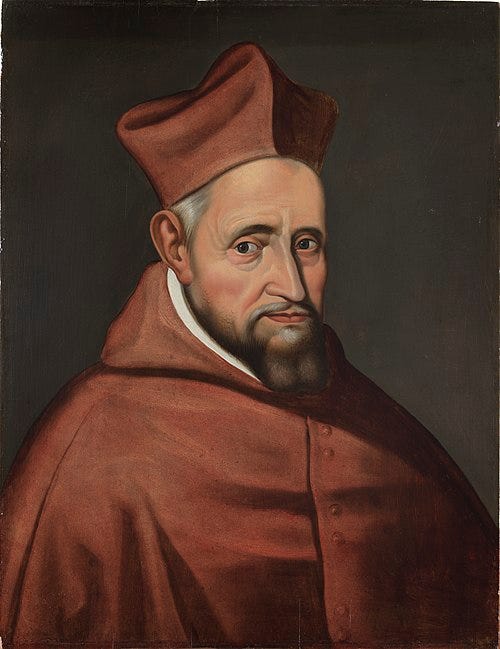
To comprehend Bellarmine's response to Galileo, we first need to understand Bellarmine himself. Born in 1542 in Montepulciano, Italy, Roberto Bellarmine emerged as one of the most influential minds of the Counter-Reformation Catholic Church. Pope Clement VIII is said to have remarked, "the Church of God had not his equal in learning."
Bellarmine established his reputation as a Jesuit theologian through his three-volume "Disputations on the Controversies of the Christian Faith Against the Heretics of This Time" (1586-1593)—a systematic defense of Catholic doctrine against Protestant challenges. These works demonstrated his meticulous approach to theological issues and his insistence on textual accuracy.
By the time of his encounter with Galileo, Bellarmine had served as the Rector of the Roman College, an examiner of bishops, the Cardinal Inquisitor, and the Archbishop of Capua. He had participated in the trial of Giordano Bruno and grappled with complex questions regarding the relationship between papal and royal powers. Far from being a reactionary figure, he was deeply engaged with the intellectual currents of his time and was committed to reform within the Church.
Bellarmine's method in addressing theological inquiries involved meticulous analysis, a focus on textual evidence, and an openness to novel ideas, though always within the limits of post-Tridentine Catholic thought. This context is essential for grasping his reaction to the Copernican challenge.
